The skate companies of St. Louis: Shapleigh and Simmons
Author Bev Thurber, 2026
Between 1850 and 1955, Shapleigh and Simmons were the two leading sellers of skates.
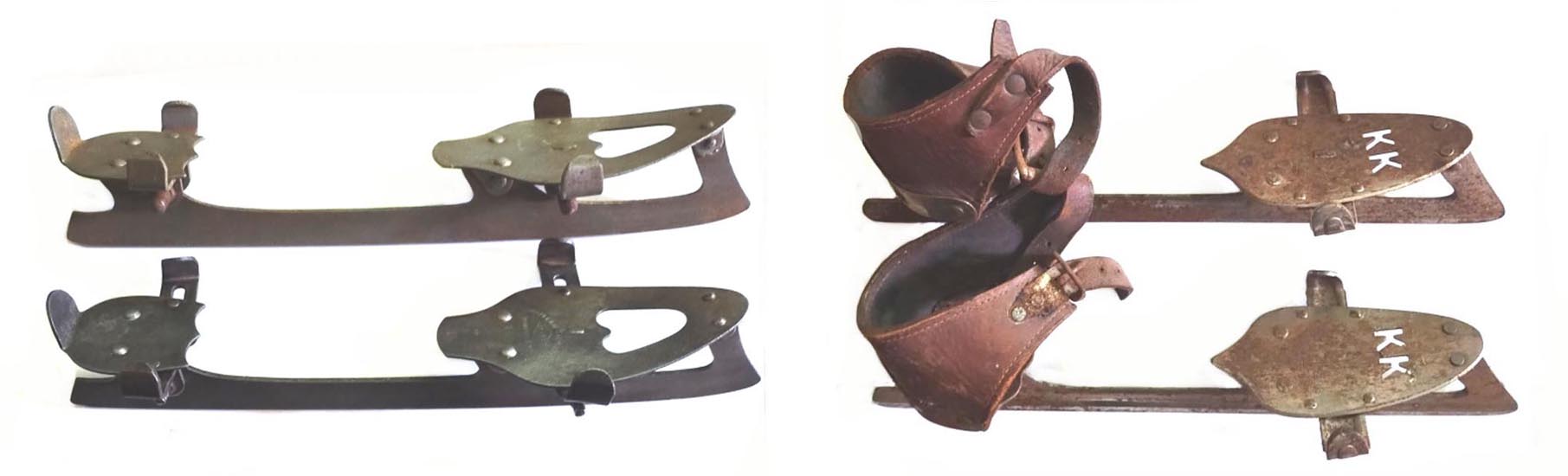
Right: Klipper Klub (KK) skates from Simmons
Shapleigh Hardware Company
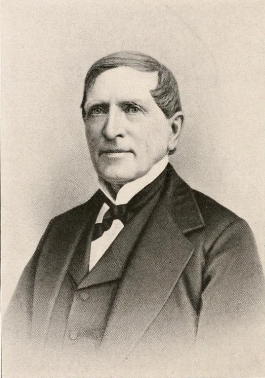
Scource: Wikipedia
The Shapleigh Hardware Company was founded in 1843 by Augustus Friedrich Shapleigh (9.1.1810–27.2.1902), an employee of Rogers Brothers and Company in Philadelphia who wanted to open a shop in St. Louis because the western part of the US was opening up.1 The firm was initially called Rogers, Shapleigh and Company, but over time, the name changed frequently (see the box).
|
The names of the Shapleigh Hardware Company 1843. Rogers, Shapleigh and Company |
The initial location was 414 Main Street between Locust and Vine, near the St. Louis courthouse.
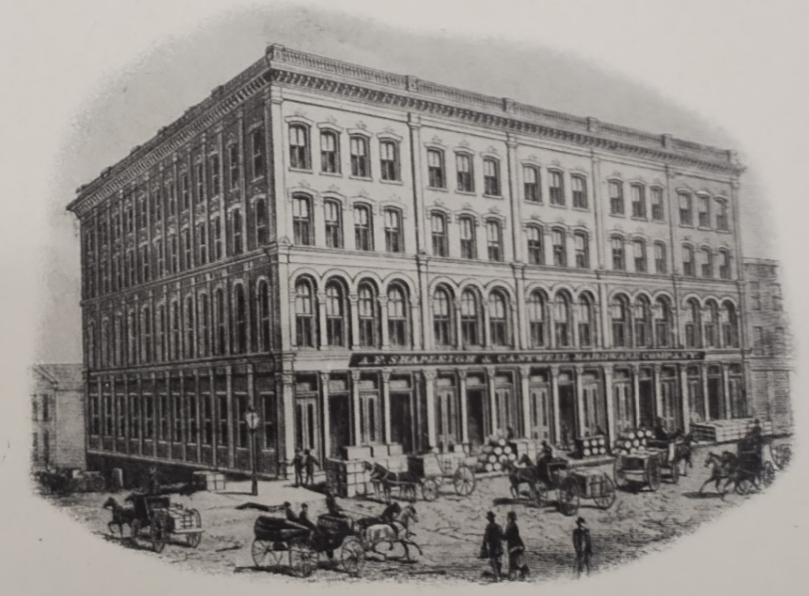
Source: One Hundred Years of Growth
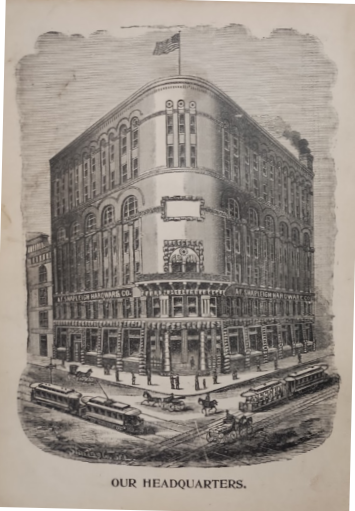
Source: Shapleigh’s Hand Book
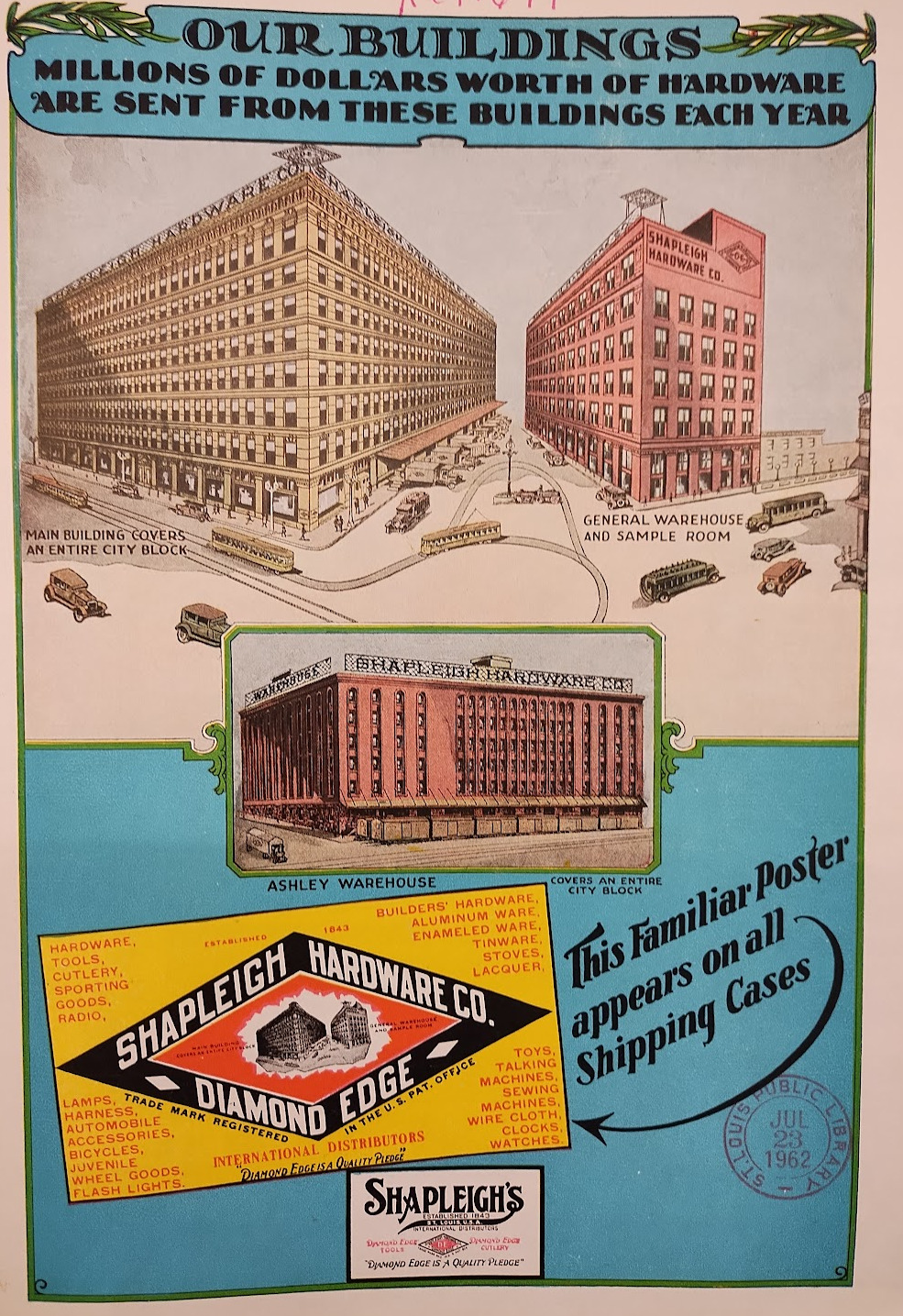
Source: Shapleigh catalog 1935
In 1848, Shapleigh started a mobile shopping service. The salesman, Ben Borgy, rode a horse with saddlebags full of hardware to sell. Whether skates were included is not known. He had a handmade price-book. The first official catalog was published in 1853 or 1873. The date is uncertain; 1853 is given in One Hundred Years of Growth and some newspaper articles, but according to the 1883 catalog, it was 1873. The 1883 catalog is the oldest catalog available in the St. Louis Public Library, but the first big catalog was published in 1880.
Things went well for Shapleigh until 1886, when the entire stock was destroyed by fire. The firm found a temporary home at 519–521 North Main St., where it stayed until January, 1891. Then, Shapleigh moved to a large building on the northwest corner of Fourth and Washington (the Boatmen’s Bank Building). In 1902, Shapleigh finally found a new home across the street in a new building on the northeast corner of Fourth and Washington. That was a large and well-known complex in which Shapleigh had stored its wares.
Shapleigh’s skates
Skaters were already being sold in 1883. The catalog offers more than 20 different models of ice skates and four of roller skates. Among them were the Ice Monarch, the New York Club skate, skates for women, and the Acme Club skate from John Forbes.

Source: Shapleigh catalog 1883
Right: The Diamond Edge logo on Shapleigh skates
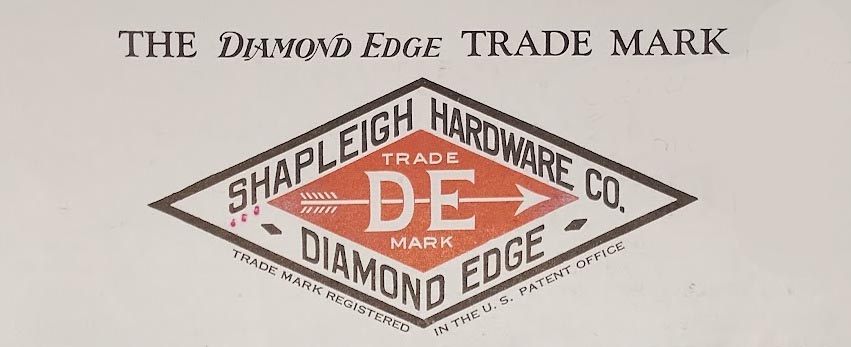
Source: Shapleigh catalog 1935
These skates were generally produced by others; Shapleigh was mainly a distributor and wholesaler. In the 1923 catalog, the firm wrote, ‘We have had the hearty co-operation of the best manufacturers; we have studied the varied needs of tool users and adopted every improvement of proven usefulness suggested by them. As the logical result, we are able to present a line of Tools of unquestioned superiority, complete in every detail of quality and service.’ Shapleigh put the Diamond Edge logo on the best products, which is also on the skates. The slogan ‘Diamond Edge is a quality pledge’ was first used in 1864.
Shapleigh sold not only skates, but also sharpeners. The 1923 catalog depicts a small sharpener that was used with a half-round file to create a groove on the bottom of the blade. This is very different from the grinding stones that were often used. These stones grind across the blade, as Wouter Groot described;2 this sharpener grinds along the blade. Shapleigh sold grinding stones too.
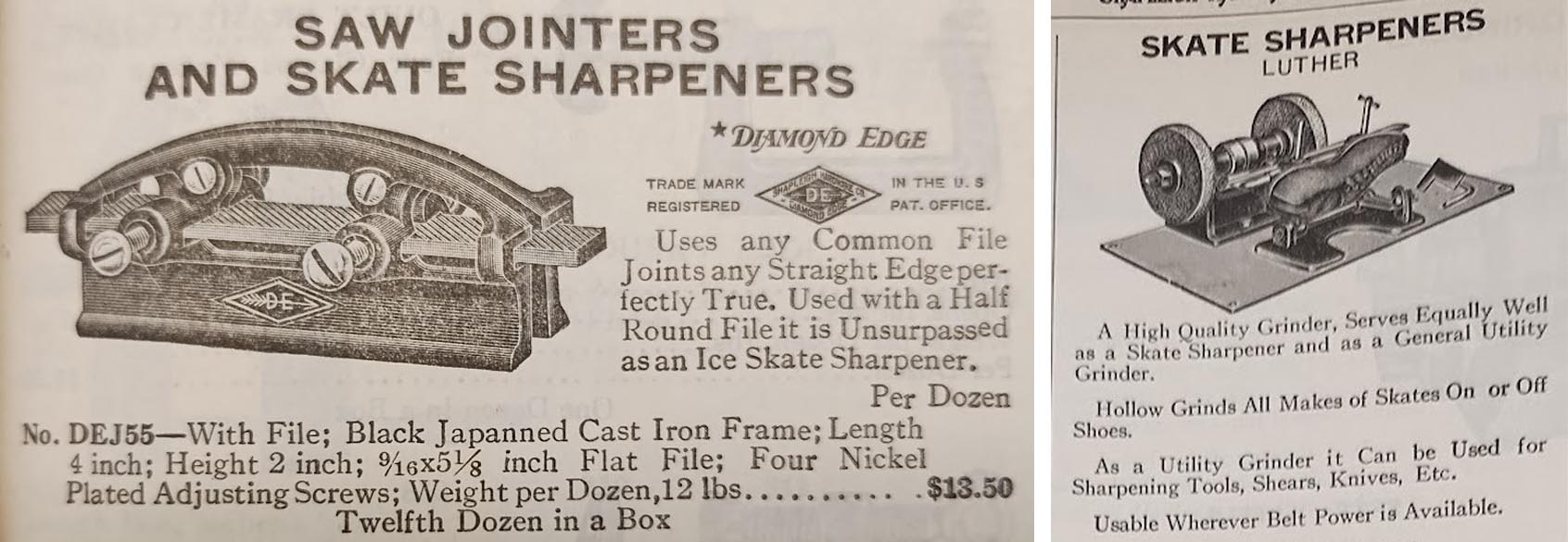
Right: The Luther sharpening machine in the 1935 Shapleigh catalog, page 126
In the 1930s, Shapleigh became enormous. The firm bought Geller-Ward-Hasner in 1937. There is no known evidence that Geller-Ward-Hasner made or sold skates. In 1940, Shapleigh also purchased Simmons Hardware Company, an important competitor in the skate market.
Simmons, The other large skate firm of St. Louis
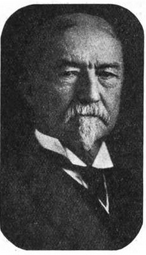
The Simmons Hardware Company was founded in 1864 by Edward Campbell Simmons (21.9.1939–18.4.1920). He was born in Maryland and moved to St. Louis when he was seven years old.3 His first job was at the firm Wilson, Levering & Waters, where he eventually became a partner.

In 1864, the firm was reorganized under the name Waters, Simmons & Company, which was changed to E. C. Simmons & Company in 1870, when Mr. Waters retired. 1874 is often named as the year in which this firm was founded, but that was the year in which the firm changed its name to Simmons Hardware Company. It was already operational. Simmons had a large warehouse complex in the city center on Ninth and Spruce. The name Keen Kutter was used on its tools.
Picture from Norvell, Forty Years of Hardware, page 284
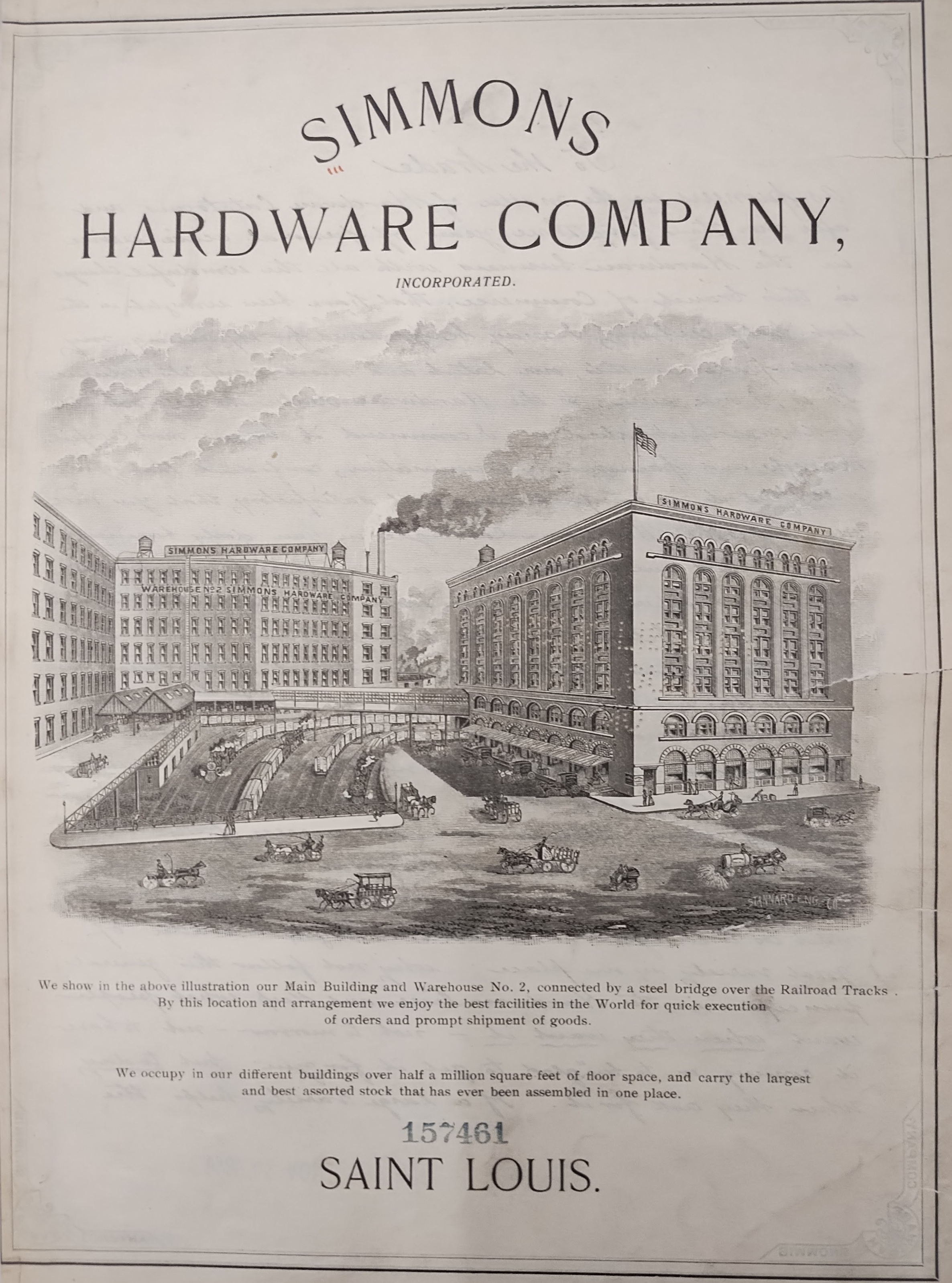
Source: Simmons catalog 1892
Simmons’ skates
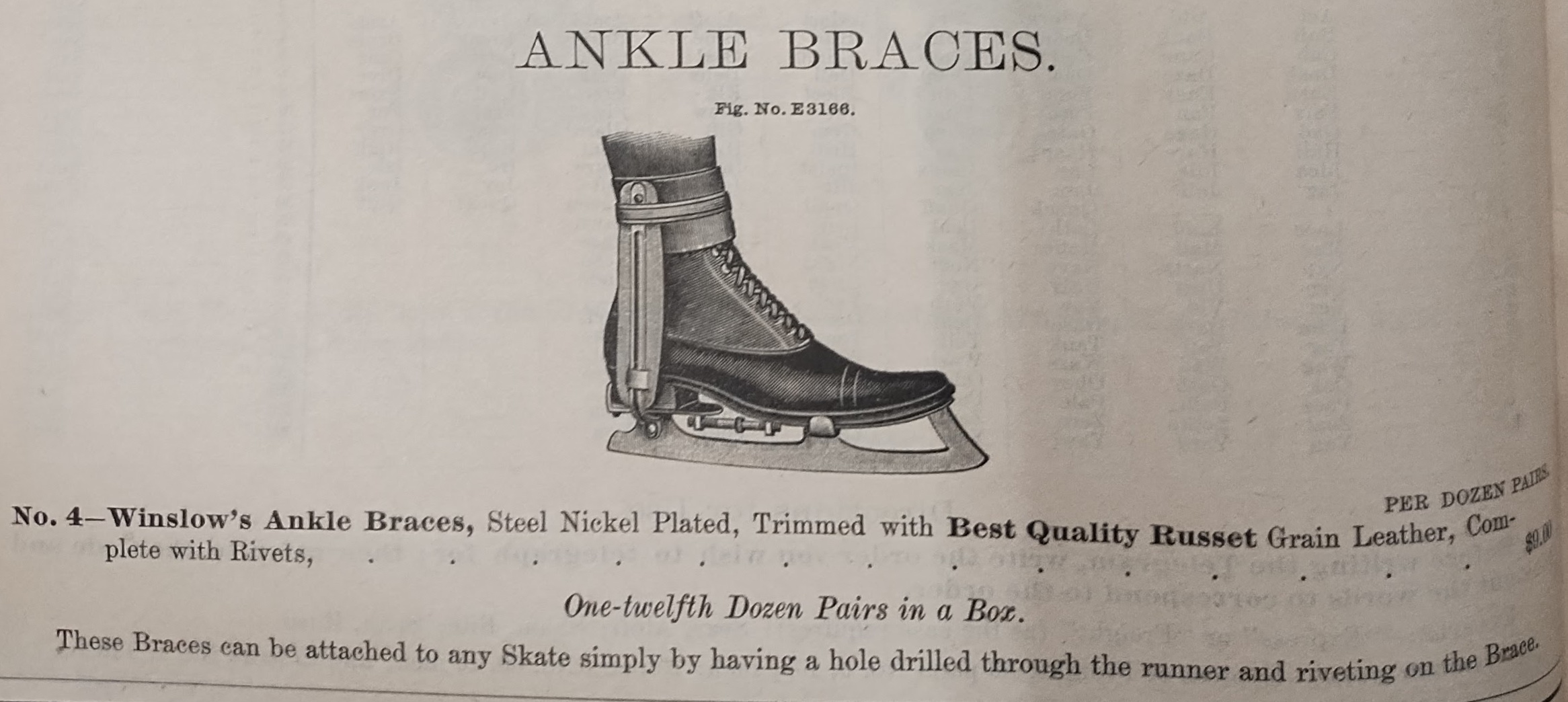
Several old Simmons catalogs are available at the St. Louis Public Library. One of them, which does not have a date, but is probably from 18924, includes Klipper Klub (three models for men and four for women) and Winslow (eight models for men and four for women) skates as well as six roller skate models and much more: guards, sharpeners, skate bags, ankle braces and so on. One of them is the Dutch Flyer skate.
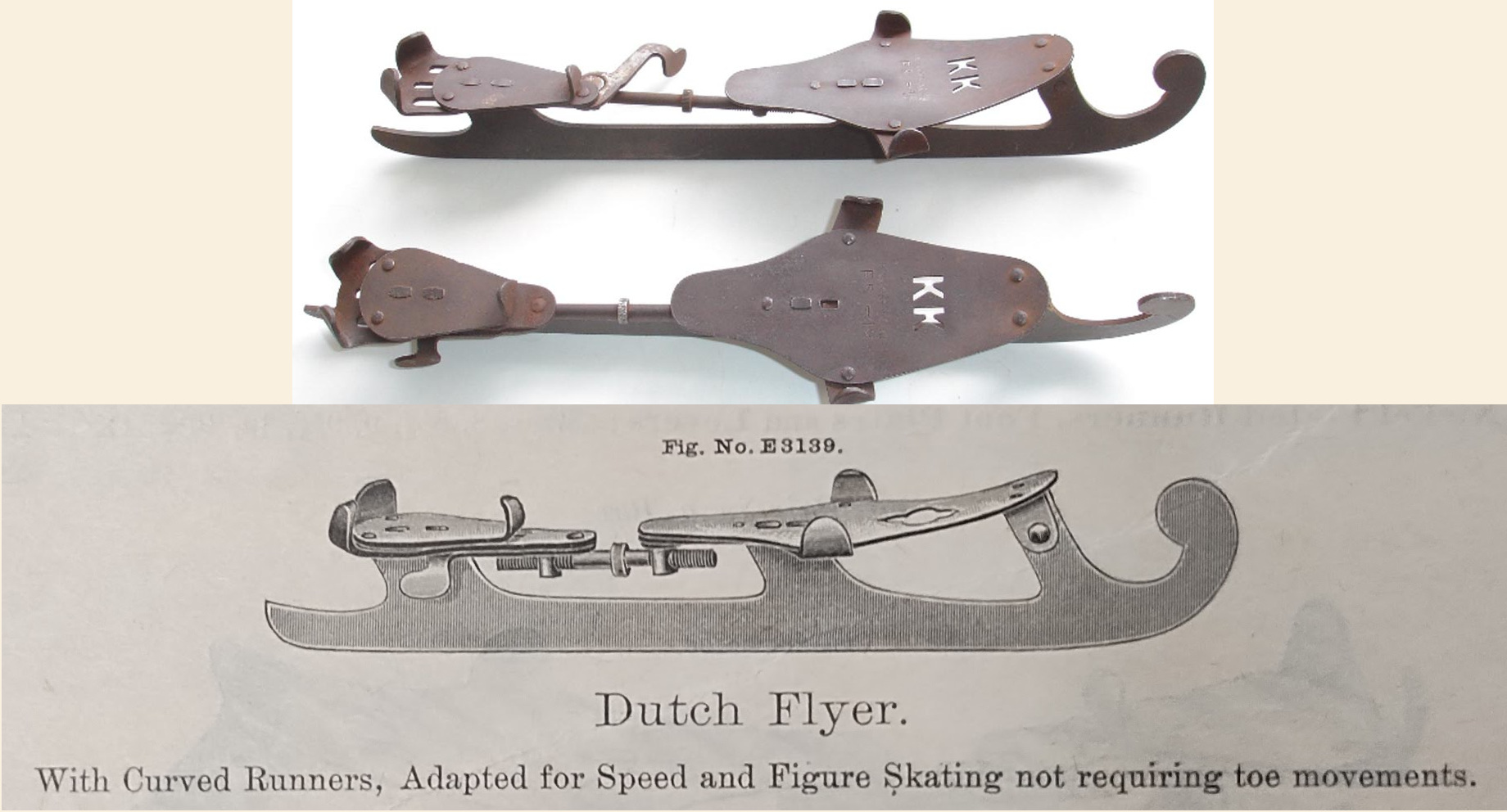
It is noteworthy that the real skates have the ‘KK’ logo, but the skate in the catalog has a clover. The skates were originally made by Winslow in 1899 and are shown on page 10 of the 1904 Winslow catalog.
The merger
In 1901, Saunders Norvell, an employee of Simmons, and his colleagues purchased 60% of the Shapleigh Hardware Company. At the time, Shapleigh was smaller than Simmons, and they worked on reorganizing Shapleigh to make it grow. Norvell described the process in his autobiography.5 Among other goals, he wanted to build up the sporting goods trade because Simmons performed better. He was successful; between 1883 and 1923 he added skis and more skate models to the Shapleigh catalog. He had a new warehouse, Warehouse No. 3 or the Ashley Warehouse, built for Shapleigh between 1904 and 1906.6 Norvell retired in 1913.
After that, Simmons started having financial problems. Newspaper articles from the St. Louis Post-Dispatch show that in the 1930s, Simmons was nearly bankrupt. In 1940, Shapleigh paid $2,712,497 for Simmons.7 Then, Shapleigh moved to the Simmons complex on Ninth and Spruce.
The end of two icons
In 1955, Shapleigh was purchased by Harold C. Schott & Associates of Cleveland, Ohio, for about $7,000,000.8 The buyers did not make good use of their purchase, according to a lawsuit: ‘The interests which took over Shapleigh Hardware Co. in 1956 have siphoned off $5,000,000 from the St. Louis firm and used the money to enrich themselves at the expense of minority stockholders, it was charged by Melroy Horn in a petition on file yesterday in circuit court.’9 Horn withdrew his claim after the firm’s new owners bought out his share.10 But it was too late, and Shapleigh went bankrupt.
In August, 1865, the large Simmons complex that Shapleigh had taken over was destroyed in a fire. The last trace from Shapleigh, the old Warehouse No. 3 building, remained standing until 2024, when it also burned down. As of early 2026, the lot is now only a field.
Sources
- The story of the Shapleigh Hardware Company is told in its own words in One Hundred Years of Growth: 1843–1943, published in 1943 and summarized here.
- Wouter Groot - Slijpen. In: Kouwe drukte 85, 2026, pages 8–13.
- Biography of E. C. Simmons. In: Walter B. Stevens - Centennial History of Missouri, 1921.
- A library stamp shows that this catalog is from before 1900; thanks to Niko Mulder for the more precise date.
- Saunders Norvell - Forty Years of Hardware, 1924, 280–310, 322–323.
- Jackie Dana - Not just another abandoned warehouse. In: Unseen St. Louis.
- Shapleigh Co. quits after 117 years. In: St. Louis Post-Dispatch, 5.1.1960.
- Shapleigh Co. quits after 117 years. In: St. Louis Post-Dispatch, 5.1.1960.
- 5-million loss of Shapleigh funds alleged. In: St. Louis Post-Dispatch, 1.5.1960.
- Suit against Shapleigh firm is dismissed. In: St. Louis Post-Dispatch, 7.5.1960.
Overige bronnen
Nile C. Smith - Shapleigh’s Hand Book, 1900.
Catalogs of the Shapleigh Hardware Company and the Simmons Hardware Company in the collection of the St. Louis Public Library.
Newspaper articles from the St. Louis Post-Dispatch and the Globe-Democrat in the collection of the St. Louis Public Library.
Credit
With thanks to Nichole Belford, Maryann Brickey, Tim Ryan, Sarah Stiehr and the staff of the St. Louis Public Library.