The language of skating history
Author Bev Thurber, 2025
When I began my research into medieval ice skating, I thought that the earliest metal-bladed skates hadn’t been studied well. That was wrong: plenty had been written, but it was all in Dutch. In the English-language literature on skating history, Dutch sources are unknown.
This situation goes back to the nineteenth century. George Herbert Fowler, an English skating historian, wrote in 1897 ‘A Dutch book is a sealed book to most of us.’1 He gave the book Schaatsenrijden [Skating] by J. van Buttingha Wichers, published in 1888, as an example. This book remains one of the best skating history books; to this day, it is better than many English-language books. In English, the same stories are told over and over, with mistakes that Buttingha Wichers had corrected repeated.
A persistent error
One example is the battle of 1572 in which Dutch soldiers were supposedly on skates.
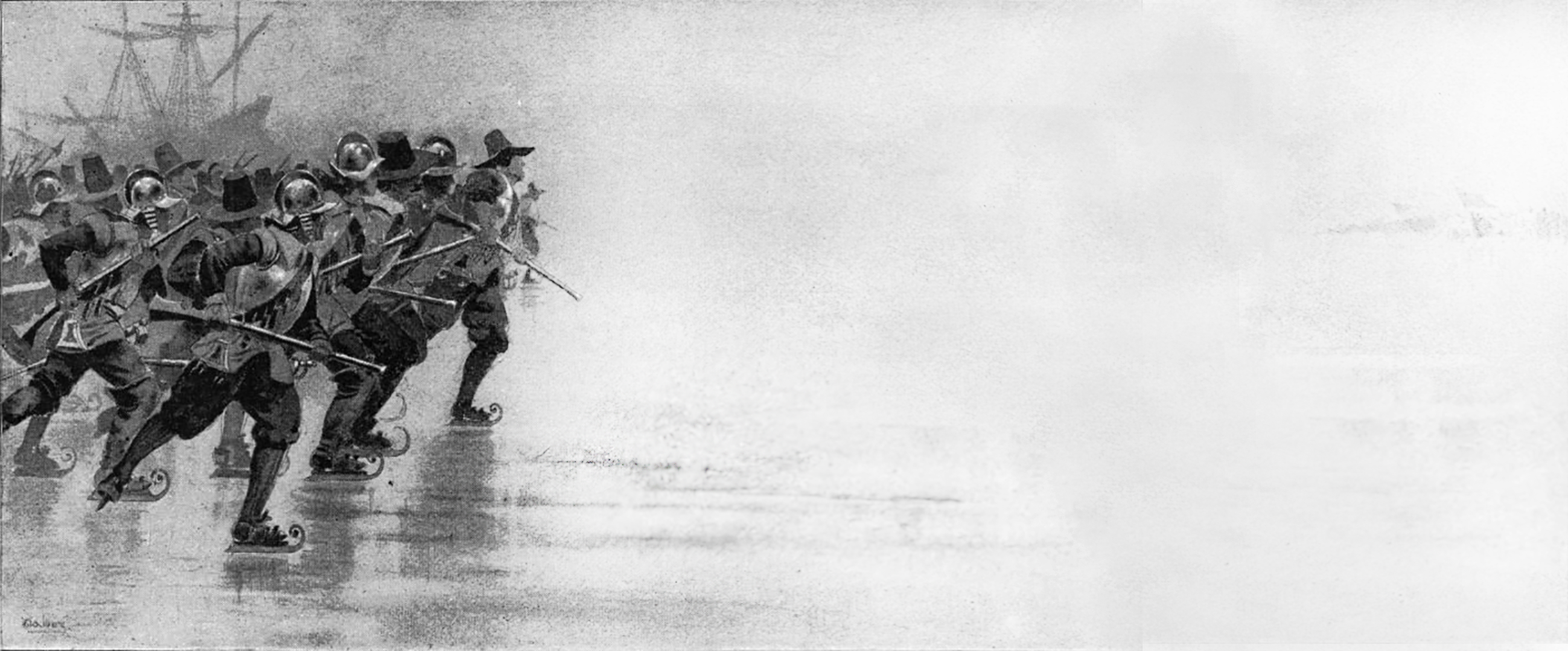
St. Nicholas 19.4, February 1892, page 244.
In his history of figure skating, James Hines wrote, ‘As the Spaniards retreated, Dutch musketeers on bladed skates surprised them by moving with the mobility skates provided. … Alva reportedly ordered seven thousand pairs of skates for his own troops, but no other known battle on skates ever occurred.’2 Buttingha Wichers had already explained that this battle did not take place on skates. He had gone back through the memoirs of Bernardo de Mendoça, who wrote ‘They had a sort of spur on … with two sharp points, on a piece of wood shod with iron, that fits in the hollow and on the sole of the foot, to enable people to stand on the ice without sliding, and thus to walk and to fight.’3 These are crampons, not skates!
Fowler cites this passage in a footnote,4 but that was not enough to stop the error from propagating. The story of how the Dutch beat the Spaniards on skates is still retold in English-language sources. The English Wikipedia article about this battle gets it wrong, despite linking to an English page on Schaatshistorie.nl that says the Dutch soldiers were on crampons, not skates.5
Today’s English speakers are neither the first nor the only people to see skating where it isn’t. This type of misunderstanding goes all the way back to the fifteenth century, when skates were put on the feet of a middle-class girl from Schiedam.6 The difference is that in Dutch sources, such mistakes get corrected, while in English, they’ve been copied from one book to the next for over a century.
Dutch skating culture
The reason for this lies in Dutch skating culture. In May, 2025, I visited the Netherlands for the first time. I went on a bicycle tour through the country, met many members of Stichting Schaatshistorie, and saw quite a few old skates.
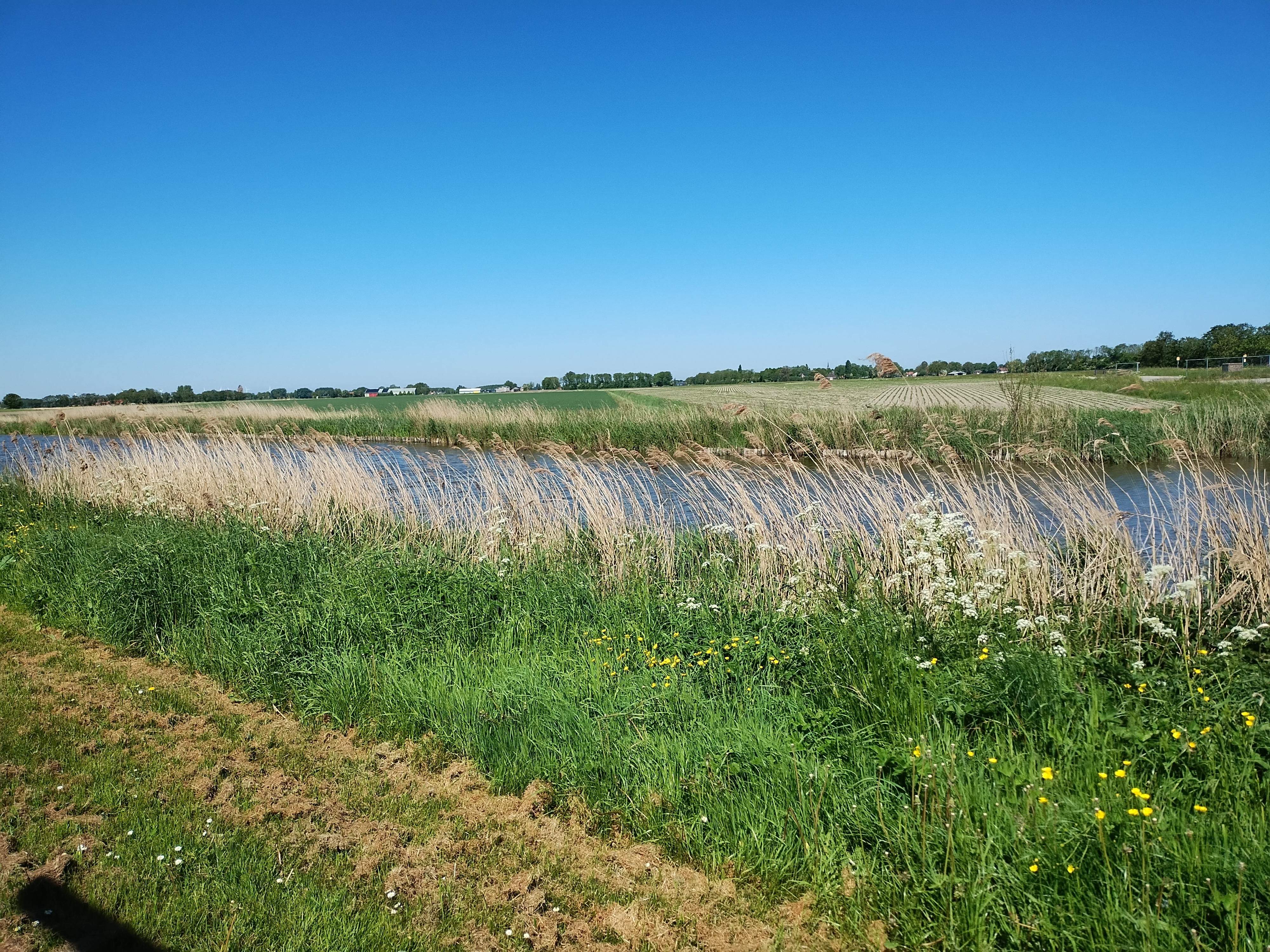
On the bike, I often thought about Dutch skating culture. As I rode along the route of the Elfstedentocht, I could easily imagine skaters zooming past. When I visited Matty van Klaveren, we followed my bike route on old maps of skating routes. These maps show a complex network that enabled skaters to travel all over the Netherlands. Some of the maps include additional notes, such as information about currents under the ice and safety tips. They create an image of a society of skaters who were connected through water.
The old skates that so many Dutch people have – in the attic or the shed, in boxes, drawers or display cases – are reminders of this society. A pair of skates was your way in. Now that Dutch winters are no longer cold enough for skaters to connect through ice, they connect through memories of skating. Collecting is a way into this culture. I saw this at the Jubileum meeting in Hindeloopen and when I visited skate collectors at home. For example, Harry Karssies has made a nice little museum in his shed. There is a large table in the middle around which people can assemble, making it more than just a museum: it’s also a meeting place, even for gatherings that are not about skating. Similarly, Aad van den Ouweelen has a bulletin board covered with newspaper clippings about people he skated with in his attic, as well as a sign from an old outdoor skating rink. These seem to me to be in the spirit of the old skating culture.
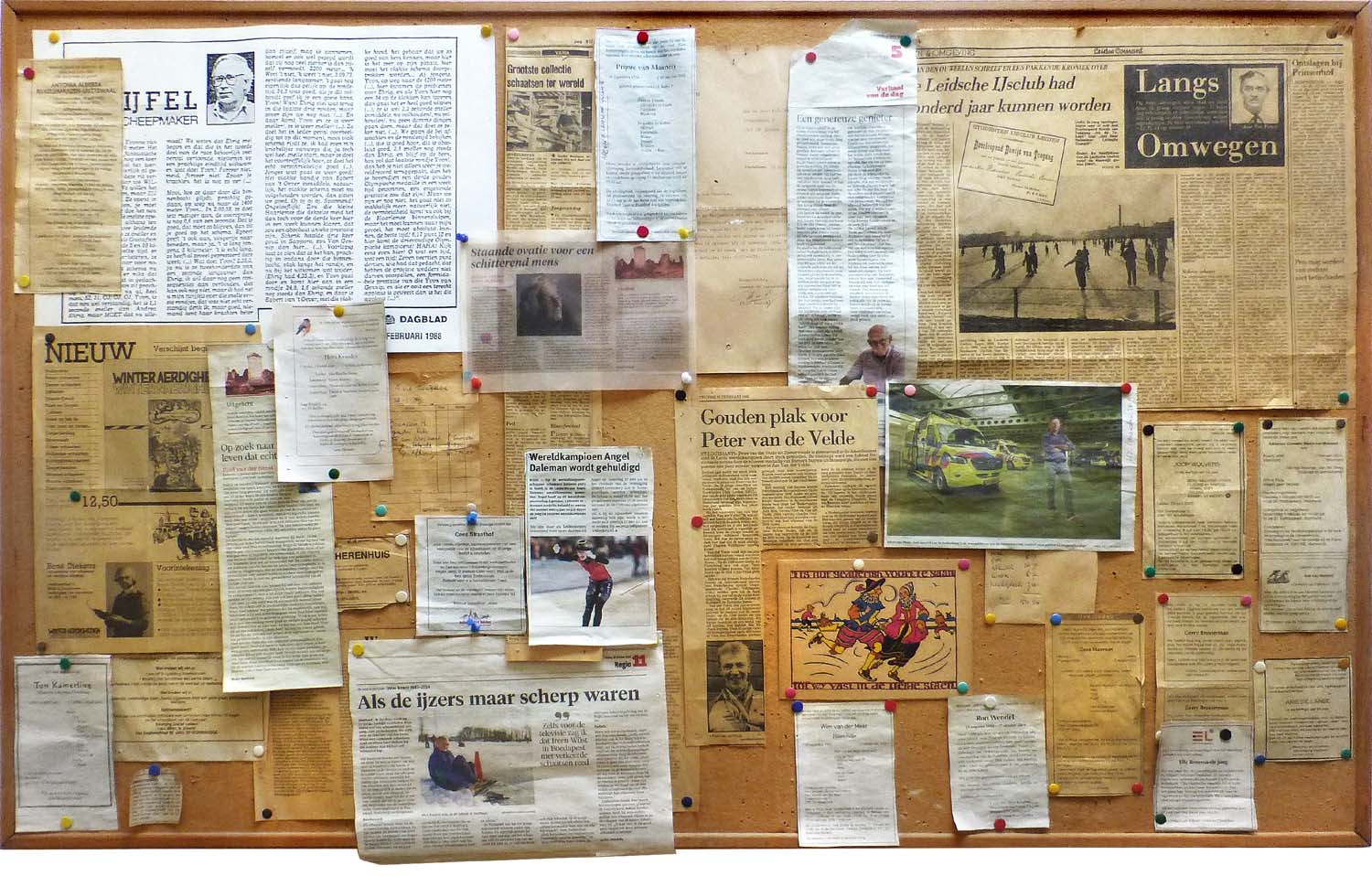
Photo: Aad van den Ouweelen.
This skating culture remains a secret from most foreigners, just as the language does. In the large museums – especially the ones with signs in English – I saw very few skates. Tourists do get a glimpse of the skating culture in the IJszaal at the Fries Scheepvaart Museum and perhaps via a few bone skates or a wood-and-metal skate elsewhere.
|
Bone skates in the Netherlands In museums, bone skates are often presented as curiosities alongside other medieval artifacts. They don’t encourage questions, but they should! So many bone skates have been found in the Netherlands that the archaeologists haven’t been able to study them all. Every collector has at least one – Jan van Eijk found one in the ditch in his backyard! – and there are many more in the depots. In the Noordelijk Archeologisch Depot in Nuis, nearly a thousand bone skates are sitting in boxes, waiting to be studied. 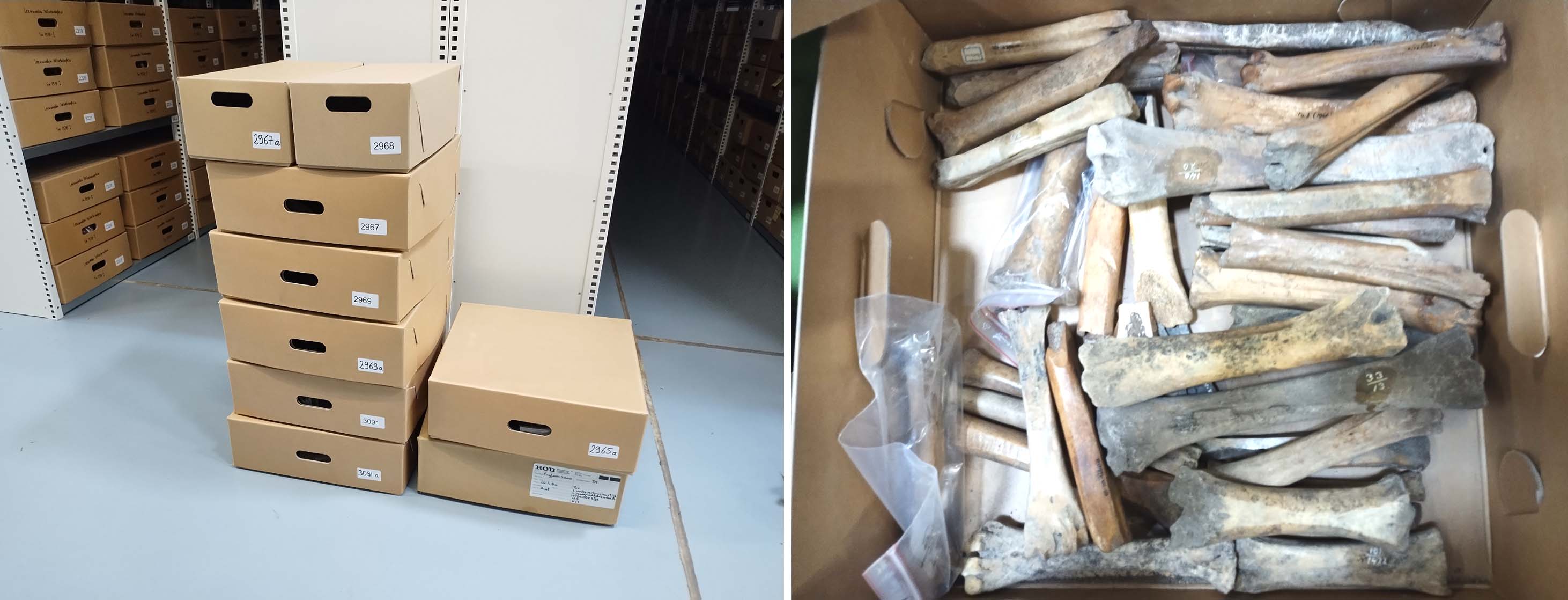
What the bone skates need is a thorough review of all the different models. H. W. Jacobi began that project in 1976 with De Nederlandse glissen [The Dutch bone skates], in which he analyzed 225 bones. That was a good start, but a bigger analysis is needed now. The hard part is that the context for most of the bone skates is unknown: the archaeologists don’t know how old they are and often not even where they were found. Despite this, there is a lot to do with the types of bone used and the modifications made to the skates. That means that a good knowledge of bone skates needs to be built up. Such a knowledge of metal-bladed skates already exists, but is sadly going away, as Hans van der Donck told me when I visited the Westlands Schaatsmuseum. The number of people who know all the historical skate models is dwindling, and few younger people are interested in preserving the information or building on it. Therefore, the exhibition at the Westlands Schaatsmuseum is designed to tell the story of skating. Yes, there are many skate models, but it is set up to avoid overwhelming with visitors incredible numbers of skates packed into display cases. |
Inhibiting progress
‘A Dutch book is a sealed book to most of us’ still holds today. Dutch books may be not only sealed but totally unknown. A good example is Wiebe Blauw’s Van glis tot klapschaats [From bone skate to klapskate], which two researchers from the United Kingdom completely missed in their research into the biomechanics of historical skating.7 For a Dutch skating historian that is an obvious oversight (Niko Mulder caught it right away), but someone who can’t read Dutch is completely shut out.
The Canadian skate collector Jean-Marie Leduc is a good example. His collection of around 350–400 pairs of skates, while not particularly large by Dutch standards, is known in North America as the largest in the world. On the cover of his book Lace up: A history of skates in Canada, he is called ‘the world’s foremost authority on skates.’ His best skate? A skate that he identified as a Norwegian model from 1452.8
For a Dutch collector, this is an obvious mistake. And I can only dismiss his 15,000-year-old skates made from buffalo bones as pure nonsense.
|
Jean-Marie Leduc’s so-called ‘medieval’ skates 
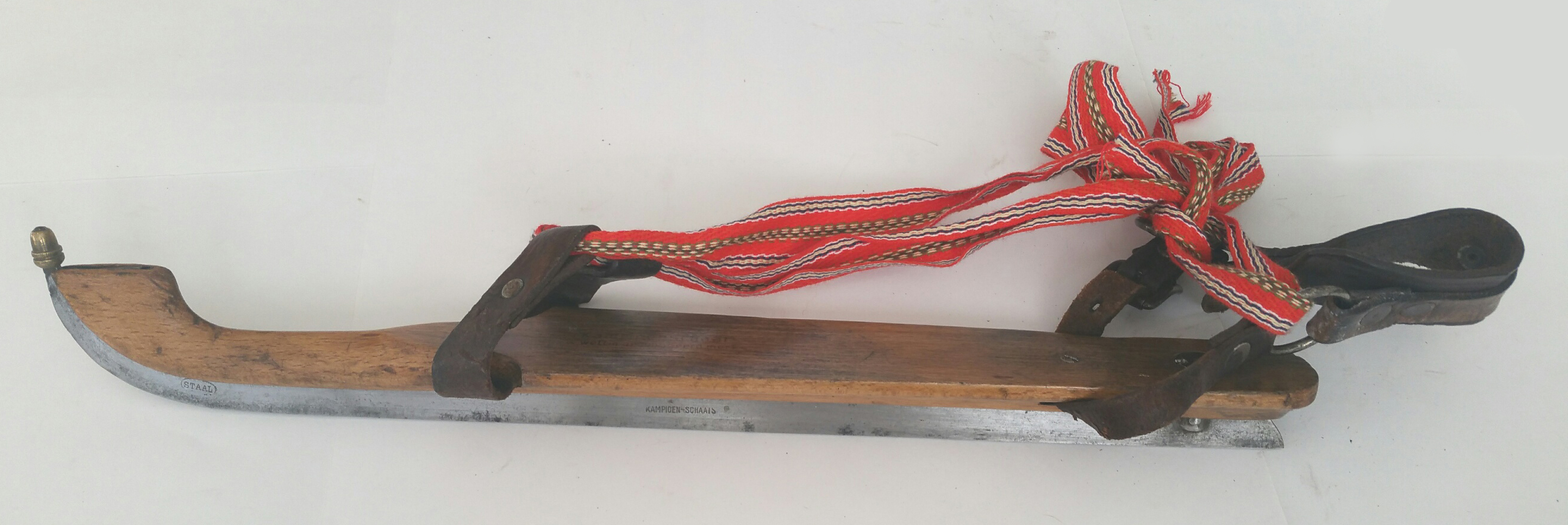
On page 30 of his book about the development of skates over the centuries, Lace up (2017), Canadian Jean-Marie Leduc wrote that the skates from 1452 were made by ‘the Staal Company’ and that the logo ‘C & Co.’ was visible on the blade. The skate in Fig. 6 is very similar to Leduc’s skate. It is a Kampoioenschaats from ca. 1930 that was made by the firm C.G. Sieben & Co. ‘Staal’ is written on the blade next to the logo ‘CG7’, which looks a bit like ‘C & Co.’. Did he misread the logo? Thanks to Ed Braakman and Frits Locher, Schaatshistorie.nl offers good information about C.G. Sieben & Co. The number 1452 could be a serial number that Leduc misinterpreted as a year. He wouldn’t be the only person to have made this mistake. I have seen eBay listings where a serial number was used to date a skate as especially old. 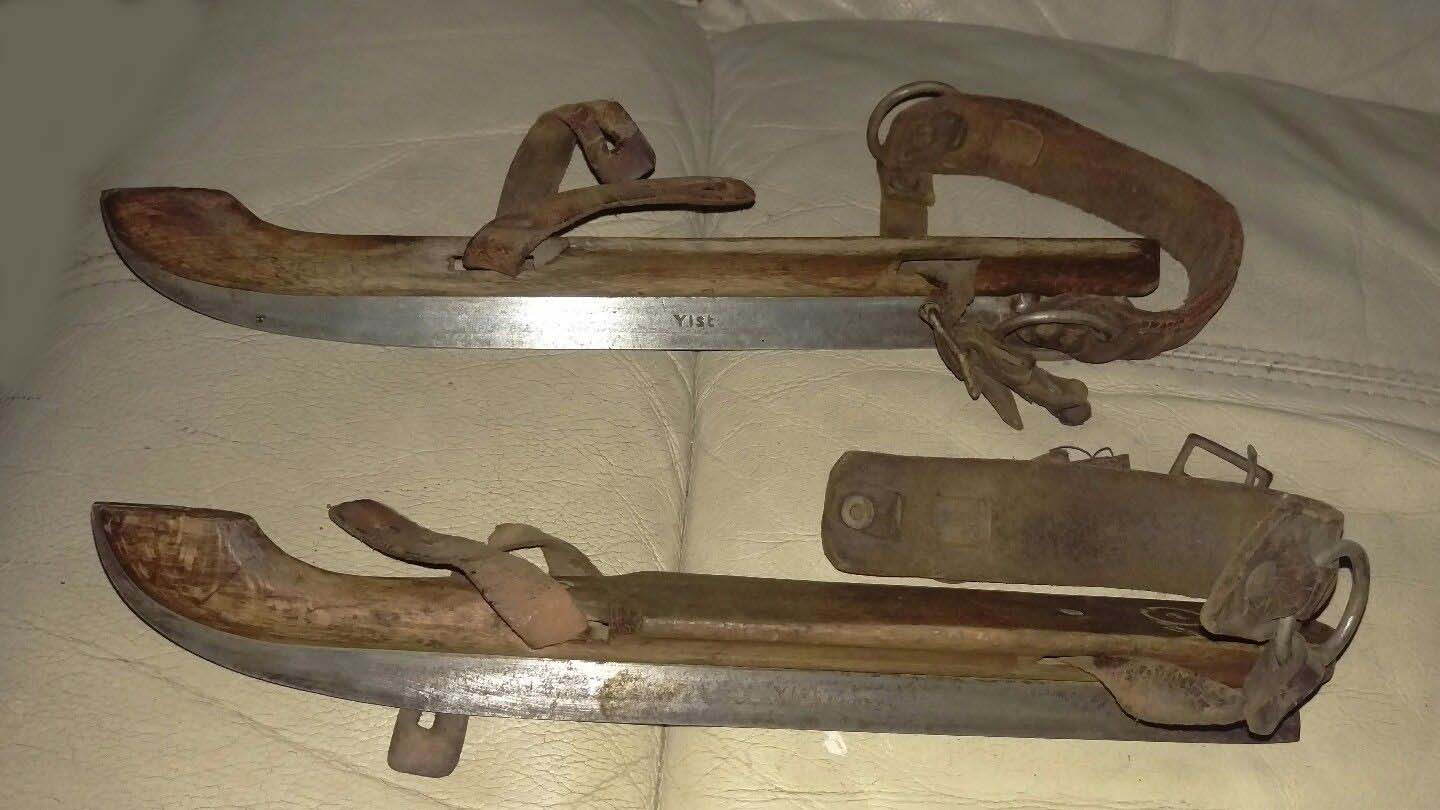
Leduc had another pair of skates that he thought were from the 1450s. Once again, Schaatshistorie.nl delivers a photo of a nearly identical pair of skates, this time a pair of Friese doorlopers made by Klaas Eeltje de Vries in IJlst. Leduc was right that these skates were about the same age as his other pair, but he was off by about 500 years. It’s too bad that he was misled by the serial number! Thanks to Frits Locher for the photos and information. |
Despite these mistakes, Leduc’s collection is interesting because of how it differs from Dutch collections. Leduc collected what he called ‘personality skates’: skates that had been used by a famous person. His collection told stories about skaters, not about the development of skates or skating. Stories about skaters are generally not the goal of Dutch collectors, but some are also told in the Netherlands. The skates that Pieter Koopman used to skate from the Hague to Leeuwarden in one day in 1763 are on view in the IJszaal of the Fries Museum.
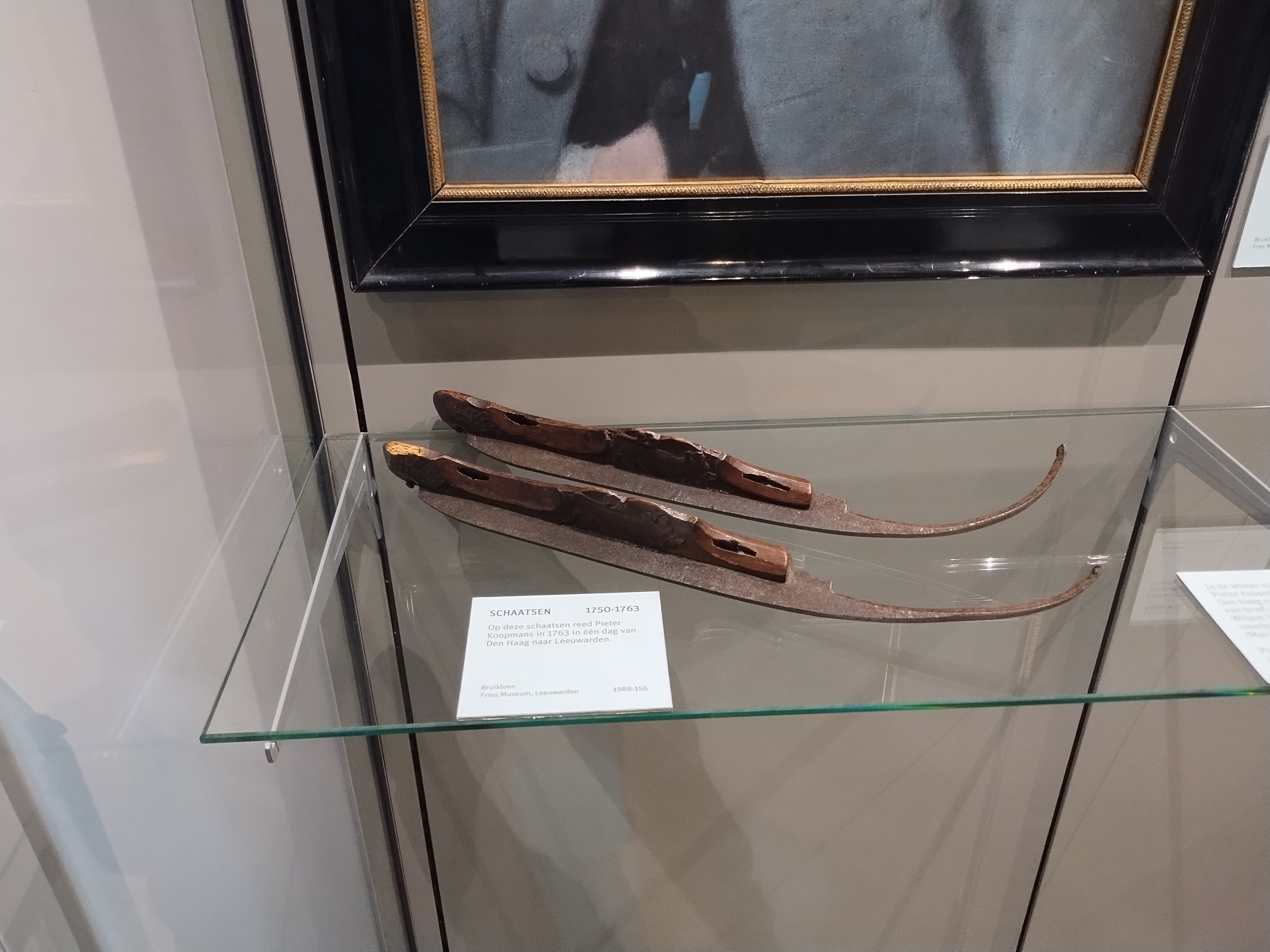
More information about this trip can be found on Schaatshistorie.nl.
Stories like this are also retold in the Elfstedentocht room of the Eerste Friese Schaatsmuseum in Hindeloopen, and every participant has a story about the race, like the one told by Harry Karssies in Kouwe drukte 84. The Elfstedenmonument in Gytsjerk shows how these stories fit together: small blue photos of around 7000 Elfstedentocht participants come together to create a single large image of the Elfstedentocht.
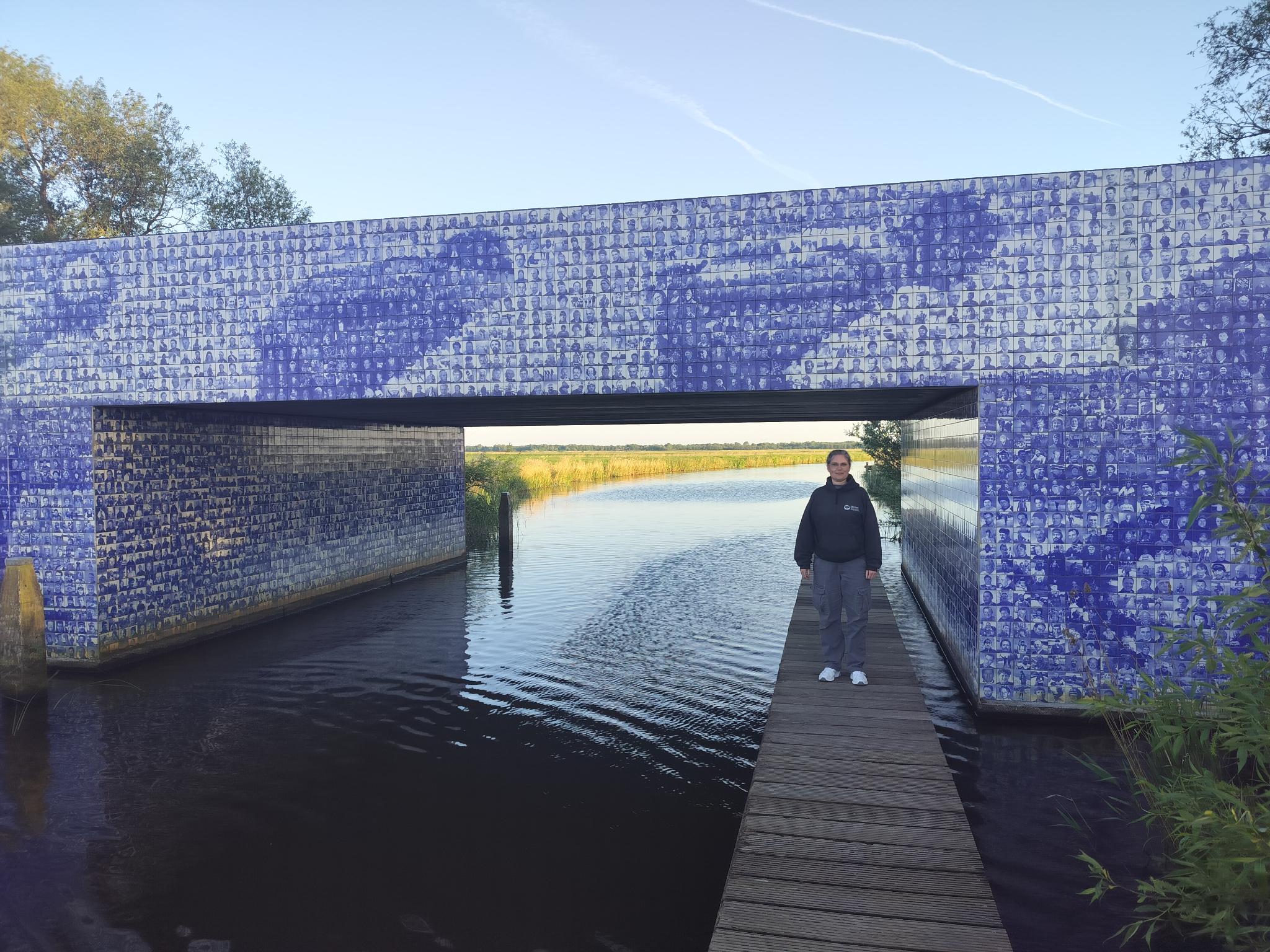
Photo: Harry Karssies.
I visited this monument with Harry and saw how these photos symbolize skating heritage through a network of people that parallels the network of routes on Matthy’s maps.
Unfortunately Leduc didn’t get the chance to become part of this network. In an interview with the Ottawa Citizen, he said that he had never met anyone who had a larger collection or knew more about skates than he did.9 How lonely he must have been! It’s a shame that he never found Stichting Schaatshistorie. He died on August 12, 2024.
Blinders
A lot of skating history is inaccessible to those who don’t know Dutch. Even for those who do, it can be hard to find information outside the Netherlands. Because I live in Chicago, Google often gives me the tip ‘Search for English results only’ and hides Dutch results, even if I write my query in Dutch. I was lucky to stumble on Schaatshistorie.nl and find Stichting Schaatshistorie.
This situation is comparable with the state of bone skates research in the 1970s. Arthur MacGregor, one of the heroes of bone skates, wrote:
‘The fact that archaeology and ethnology had useful things to say to each other became obvious from the beginning of my interest in animal bones. Having gathered references to archaeological works which “proved” scientifically that certain polished bones from the early medieval period were used in leather working, I was fortunate to discover a more extensive and persuasive ethnographical literature which showed the same objects to be ice skates, in regular use in certain communities up to the present century.’10
These objects were bone skates. Early metal-bladed skates are also sometimes incorrectly interpreted or remain unknown outside of the Netherlands.
Dutch is a must
It’s often said that if you know English, you don’t need to learn Dutch because in the Netherlands, everybody speaks English. That may be good enough for tourists and people with a superficial interest in skating history, but true geeks must learn at least to read Dutch. Otherwise they’ll miss too much, and not just older sources like Buttingha-Wichers. Archaeological research is supported by Dutch taxpayers who, according to James Kennedy, an American historian with excellent Dutch, ‘have the right to research results in beautiful Dutch prose, partly because researchers should not become alienated from Dutch society.’11
Despite this, a shift from Dutch to English is visible in scholarly literature: although older archaeological reports are usually in Dutch, the newer ones are often in English. Bone skates and old metal-bladed skates are mentioned for the first – and sometimes only – time in these reports, often without details. The details are almost exclusively available in Dutch-language sources like Kouwe drukte because, as the world learned from Hans Brinker, skating is a part of Dutch cultural heritage.
This article ought to end with a call to action. Skating historians need to learn Dutch, just as the archaeologists needed to learn to use ethnographical sources. Those who already know Dutch can help by making enough research available in English to pique the interest of those who don’t. English may be the international language, but Dutch remains the language of skating history.
Sources
This article was previously published in Kouwe drukte 83 and 85 in a different form.
- G. Herbert Fowler - On the outside edge, 2018 [1897], p. 26.
- James R. Hines - Figure skating: A history, 2006, p. 19.
- J. van Buttingha Wichers - Schaatsenrijden, 1888, p. 86. My translation.
- G. Herbert Fowler - On the outside edge, 2018 [1897], p. 32.
- Wikipedia Battle of IJsselmeer.
- Niko Mulder - Lidwina of Schiedam - on skates or on pattens?. In: Kouwe drukte 77, 2023.
- Federico Formenti and Alberto E. Minetti - Human locomotion on ice: The evolution of ice-skating energetics through history. In: Journal of experimental biology 210: 1825–1833, 2007.
- Jean-Marie Leduc - Lace up: A history of skates in Canada, 2017, p. 25, 30-31.
- Ottawa man’s ‘unique’ skate collection sharpest thing on ice. In: Ottawa Citizen, January 16, 2015.
- Arthur MacGregor - Bone, antler and horn: An archaeological perspective. In: Journal of museum ethnography 2: 28–38, 1991, p. 29.
- James Kennedy - In het Engels vloeken lukt beter dan spreken. In: Trouw, 13 juli 2013. My translation.